

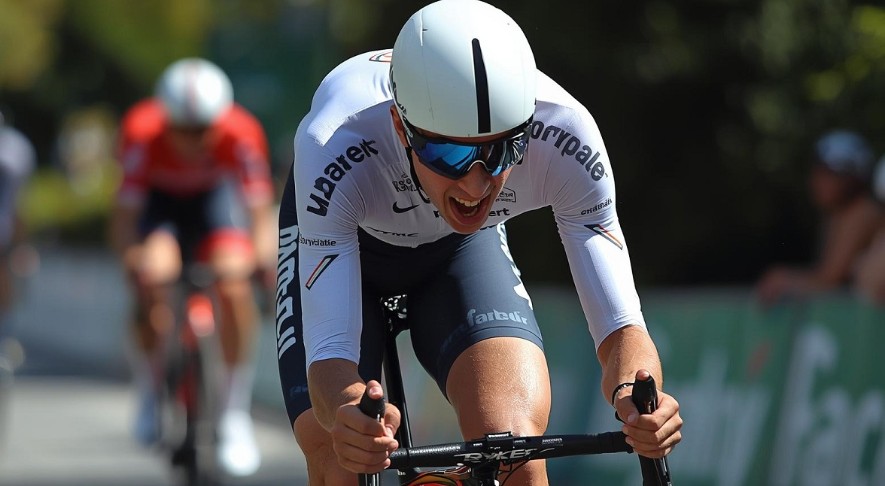
High-performance cycling has evolved from a simple test of physical endurance into a high-stakes game of “chess on wheels,” where technology and strategy merge. Following a mountain stage in the Tour de France or a Spring Classic now requires spectators to understand variables such as Normalized Power or drag coefficients. This depth of analysis has led many fans to seek platforms like Te Apuesto to cross-reference their knowledge regarding team leaders’ performance. Likewise, in the age of digital convergence, modern fans alternate between following the race and other forms of technological entertainment, valuing options like an online casino bonus to complement their leisure time during long television broadcasts.
The Art of “Sitting In”: The Aerodynamic Advantage
One of the most fascinating concepts in cycling is energy conservation through drafting. A cyclist staying within the peloton can save up to 40% of their energy compared to the rider leading the pack and breaking the wind. This dynamic turns the peloton into a living organism that expands and contracts based on wind direction.
Team strategy is based almost exclusively on this principle. “Domestiques” sacrifice their own performance to protect their leader, shielding them from the wind until the critical moment of a climb or the final sprint. In modern cycling, even the angles of attack from crosswinds are analyzed to decide when to execute an “echelon” (abanico)—a tactical maneuver that can shatter the race and distance the favorites on flat sections.
Also Read: https://alpinecasino.co.uk/
The Data Revolution: Watts and Marginal Gains
Today, it is impossible to understand professional cycling without power meters. These devices measure, in real-time, the force a cyclist exerts on the pedals, expressed in watts. Unlike heart rate, which can be affected by heat or fatigue, wattage is an absolute measure of effort.
Sports directors monitor this data from their cars to provide precise instructions. They know exactly how many watts their leader can sustain during a 10-kilometer climb without “blowing up.” This effort management, powered by Big Data, has eliminated much of the improvisation of the past, ushering in an era of “marginal gains” where every gram of weight on the bike and every calorie consumed is meticulously calculated.
The Psychology of Suffering in Grand Tours
Beyond wind tunnels and strict diets, cycling maintains a brutal psychological component. In three-week competitions like the Giro d’Italia, the nervous system’s recovery capacity is just as important as leg strength.
Mental resilience defines champions. The ability to maintain focus during descents at 90 km/h after five hours of extreme physical exertion is what separates stage winners from the rest. Modern analysis also attempts to quantify this factor, studying Heart Rate Variability (HRV) as an indicator of an athlete’s stress levels and mental freshness before a decisive stage.
A Global Sport in the Information Age
The impact of Latin American and Slovenian cyclists over the last decade has globalized a sport that was previously predominantly Franco-Belgian or Italian. This has generated a constant flow of analytical information available to fans via apps and social media.
Data transparency—with many pro cyclists uploading their rides to public platforms—has allowed fans to feel like part of the team. Understanding the telemetry of a final sprint or the energy expenditure of a solo breakaway in the Pyrenees allows for a much more technical and satisfying appreciation of the sport. Cycling is no longer just about pedaling; it is a complex interaction of physics, biology, and real-time data.
